





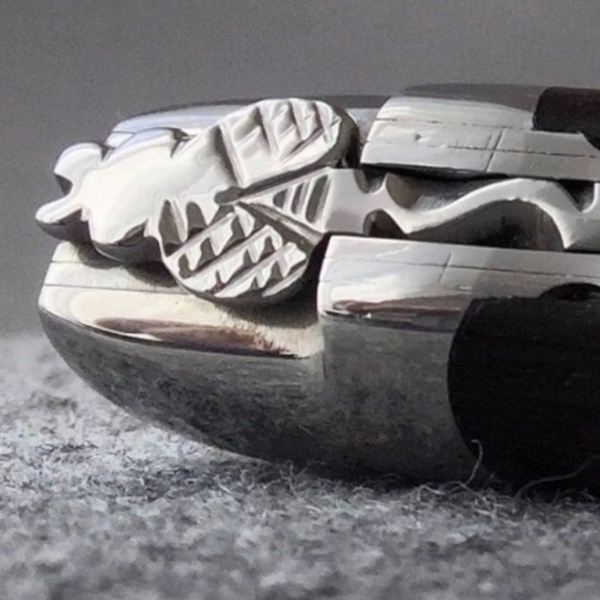
Few details are as immediately identifiable on Laguiole knives as the small insect perched on the back of the handle. Delicately shaped and often highly polished, the bee has emerged as a defining visual feature associated with Laguiole knives. For numerous individuals, it is the initial detail that captures their attention: a small emblem that appears almost ornamental at first sight, yet embodies a captivating blend of artistry, cultural identity, mythology, and historical ambiguity.
The narrative surrounding the bee on Laguiole knives is notably intriguing, as the symbol lacks a singular, universally accepted origin. Its history intertwines an ancient piece of cutlery terminology, evolving decorative traditions, and subsequent legends that contributed to the bee’s transformation into a lasting symbol. Recognising that the narrative unveils significant insights about Laguiole knives: their essence has consistently been influenced by both tradition and interpretation, alongside practical design.
To comprehend the bee, one must first examine the origins of Laguiole knives. The style originated in the early nineteenth century in the village of Laguiole, located on the Aubrac plateau in southern France. The earliest forms were relatively simple working knives, designed for practical everyday use by farmers and rural labourers. As time progressed, the design evolved, taking on its unique curved profile, polished blade, and signature spring.
The earliest Laguiole knives lacked the recognisable bee emblem. Their springs and the small metal component typically linked to the front of the spring were usually plain and unadorned. In other words, the insect that is now instantly recognisable on many Laguiole knives was not included in the original design from the outset.
This point is significant as it distinguishes historical development from subsequent mythology. Laguiole knives evolved over time, and their decoration transformed as the knives transitioned from their initial function as simple agricultural tools.
The essence of the bee’s narrative is encapsulated in the term traditionally employed by French cutlers: “fly”, or “mouche”. In traditional cutlery terminology, the term did not denote an insect but rather a small metal part linked to the knife’s mechanism. In earlier folding knives, this component may have served a practical function in the operation or closure of the blade. As the Laguiole design evolved and its locking mechanism transformed, the significance of the original mechanical function diminished. The feature, however, remained as an integral aspect of the knife’s decorative design.
This gives rise to one of the intriguing mysteries associated with Laguiole knives. The entity that is now widely referred to as a bee has a historical connection to something that was once known as a fly. The two terms thus illustrate distinct facets of the same design history: one pertains to the terminology of cutlery construction, while the other denotes the insect-like form that ultimately became closely linked with Laguiole knives.
In the late nineteenth century, the decoration on Laguiole knives grew more intricate. Floral and geometric motifs started to emerge on the springs, supplanting the previous unadorned look. This period was notable as the knife was slowly developing a more polished identity. What had started as a functional tool in the countryside was evolving into an item where both skilful craftsmanship and decorative elements could be valued alongside its practicality.
The bee emerged from this ornamental evolution. Historical accounts indicate that the recognisable bee motif first appeared on Laguiole knives around 1908–1909. At this point, the symbol had evolved into a recognisable emblem of the knife itself.
This dating is especially enlightening. The bee was not inherently an ancient symbol intentionally incorporated into Laguiole knives from their inception. Instead, it gained prominence during the time when the decorative language of the knife was becoming more established. Its significance increased over time, ultimately rendering it nearly indistinguishable from the identity of Laguiole knives.
However, history by itself does not account for the reasons behind the bee’s emergence as a potent symbol. This is the starting point of legends.
One of the most enduring tales suggests that the bee emblem on Laguiole knives is linked to Napoleon. According to the legend, Napoleon I bestowed upon the inhabitants of Laguiole the privilege to use the bee as a symbol of honour or recognition after an act of bravery. Another interpretation links the narrative to Napoleon III. The story is captivating as the bee has long been a significant imperial symbol in French history, and its association with the evolution of Laguiole knives forges a romantic bond between the knife, France, and military honour.
There is, nonetheless, an important caveat. No historical document has been discovered to verify that either Napoleon I or Napoleon III bestowed upon the people of Laguiole the privilege of placing a bee on their knives. The story is best understood as folklore rather than established fact. It is part of the rich oral tradition associated with Laguiole knives, rather than the recorded history of their production.
That distinction does not diminish the significance of the legend. Indeed, legends can play a crucial role in shaping the understanding of traditional objects. The narrative of Napoleon contributed to imbuing the bee with significance that transcended mere ornamentation. It conveyed a sense of bravery, uniqueness, and French heritage, transforming the small figure on Laguiole knives into a symbol of identity.
There exists a more pragmatic interpretation of the bee. The insect serves as a representation of hard work and skilful creation. A bee operates in harmony, tirelessly and with exceptional accuracy, traits that clearly resonate with the craftsmanship typically linked to Laguiole knives. The bee serves as an apt metaphor for the cutler: intricate details, consistent actions, and patience come together to create something that is both functional and aesthetically pleasing.
The natural symbolism aligns perfectly with the landscape where Laguiole knives were born. The Aubrac plateau is a rural setting where agriculture, seasonal migrations, and a deep connection to the land have historically influenced daily life. A bee is an integral part of the natural world, rendering the motif a captivating representation of the countryside that envelops the knife’s origin.
This symbolism holds particular significance when examining the craftsmanship of Laguiole knives. The bee is situated on the spring, a highly noticeable feature of the handle. It is neither concealed nor regarded as a mere afterthought. Instead, it occupies the central position of the knife’s decorative design, where the eye is naturally drawn to it.
On exquisitely crafted Laguiole knives, the connection between the bee and the spring can also showcase the craftsmanship involved in creating the knife. The spring can be meticulously crafted and adorned, while the bee can be seamlessly incorporated into the overall design. The outcome transcends mere decoration; it integrates into the visual cadence of the knife.
The bee also plays a significant role in the distinctive silhouette of Laguiole knives. Open or closed, these knives feature a unique blend of graceful handle lines, a curved spring, and an ornate spine. The bee serves as a subtle focal point within that design. Eliminate it, and the knife may instantly appear less distinctive, although its practical functions will remain intact.
Interestingly, not every decorative figure on Laguiole knives needs to be understood strictly as a biological bee. The earlier terminology related to the “fly” continues to play a significant role in the narrative, and historical interpretations recognise the ambiguity regarding whether the initial motif should be perceived as a stylised fly, a bee, or another insect-inspired design. What is important is that the bee interpretation ultimately became the prevailing view and gained its own cultural importance.
The history of Laguiole knives illustrates the evolution of symbols and their meanings. A functional cutlery component might transform into a decorative piece; a decorative insect could evolve into a bee; and that bee could subsequently represent quality, regional identity, and tradition. None of these stages needed to occur according to a singular master plan. They evolved over time as successive generations of creators and users imparted new significance to the knife.
The bee is an integral element of the broader tradition of symbolism present on Laguiole knives. Another notable characteristic is the cross created by small rivets in the handle. A longstanding tale links this decoration to shepherds, who are said to have used their knives as a small token of faith while journeying in the mountains away from home. Similar to the tale of the bee, this tradition intertwines historical potential with folklore, illustrating how Laguiole knives evolved into items that embody narratives alongside their practical uses.
Ultimately, the allure of the bee resides in the understanding that its narrative does not need to be confined to a single, definitive explanation. The documented history indicates that early Laguiole knives were simple in design, with decorative springs emerging at a later stage, and the iconic bee motif becoming prominent around the early twentieth century. The term “fly” offers insight into another aspect of the knife’s mechanical history, while the Napoleonic tale adds a vibrant legend that has influenced popular perception.
Together, these threads elucidate the reasons behind the bee’s resilience.
For over a hundred years, the small emblem has played a crucial role in elevating Laguiole knives from mere functional folding tools to items that are instantly linked to a distinct tradition of French cutlery. It embodies artistry, while also conveying narratives. It links the knife to nature, rural life, and the landscape of Aubrac, while the legends that surround it add an extra layer of intrigue to the design.
Perhaps that is the reason the bee continues to captivate us. It is small in comparison to the blade and handle, yet it holds an incredible depth of significance. On Laguiole knives, the bee is not merely an ornament affixed to the metal. It represents the culmination of a lengthy evolution where function transformed into decoration, decoration evolved into symbolism, and symbolism ultimately solidified into tradition.
The most accurate account of the bee on Laguiole knives is not merely one legend. It embodies a blend of history, craftsmanship, and folklore. The bee may not have been bestowed by an emperor, nor may it have adorned the earliest knives, yet it has become an integral part of the identity that Laguiole knives have cultivated through the ages.
Ultimately, that uncertainty arguably enhances the symbol’s intrigue rather than diminishes it. Each bee on a collection of Laguiole knives serves as a subtle reminder that traditional objects embody living histories. Their meanings are influenced not just by the creators, but also by those who engage with them, appreciate them, and share their narratives. The bee has endured because it embodies the essence of what the finest symbols should achieve: it encourages us to examine more closely.